The move towards energy and ecological transitions makes it essential to place complexity at the heart of the analysis of socio-environmental systems, in order to better understand contemporary issues at the interface of biodiversity, climate, and socio-economic dynamics.
Rather than considering these dimensions in isolation, it is necessary to articulate them in a systemic and de facto interdisciplinary approach, drawing on expertise not only in ecology and physical sciences but also in many fields of the humanities and social sciences.
We must integrate these interactions in order to better anticipate the long-term effects of our technological choices, revealing the co-evolution of environmental and human dynamics. Take energy policies, for example: their impacts are not limited to carbon footprints or technical production. They affect biodiversity, change land use, influence social and economic dynamics, and generate sometimes unexpected indirect effects. The interconnections between disciplines and feedback loops must now be systematically taken into account in any reflection, or even ambition, relating to the “global” transition.
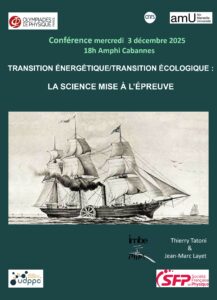
Date: Wednesday, December 3, 2025, at 6 p.m.
Location: Cabannes Lecture Hall – St Jérôme campus – Aix Marseille Université