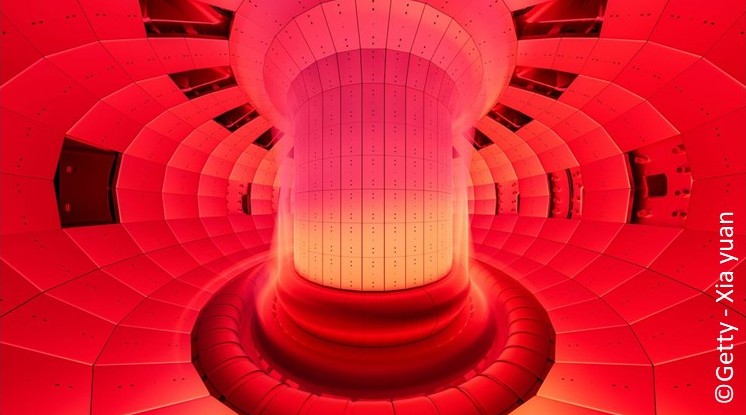
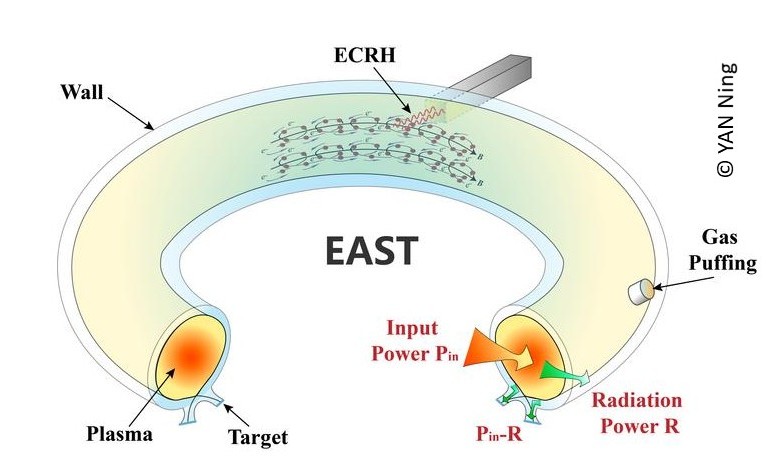
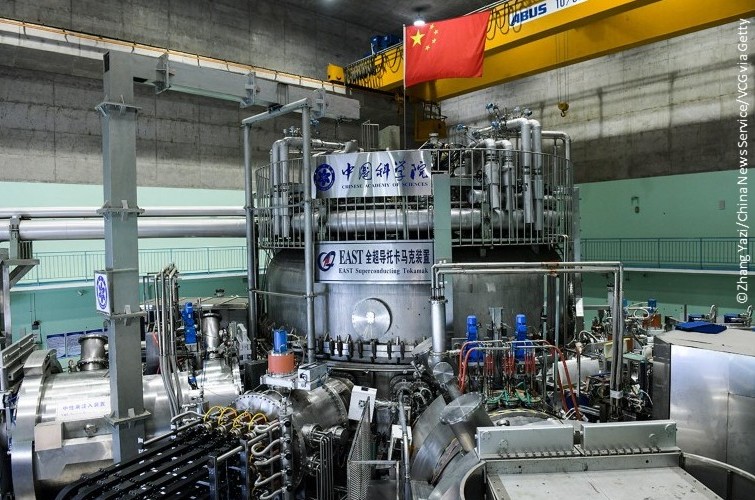
To produce fusion on Earth, extreme conditions must be recreated: heating matter to over 100 million degrees, transforming it into plasma, then confining it long enough for the hydrogen nuclei to fuse. Unlike stars, where gravity naturally provides this compression, humans must use ingenuity. Two main approaches dominate today: inertial confinement, which briefly compresses a target with lasers, and magnetic confinement, which traps plasma in powerful magnetic fields, particularly in machines called tokamaks. But this plasma is extremely unstable. The higher its temperature and the greater the amount of matter it contains, the more difficult it becomes to control. This boundary, identified empirically in the 1980s, is known as the Greenwald limit and, until now, could not be exceeded.
It should be noted that, for reasons of format, Dominique Escande’s interview with France Culture was not broadcast in its entirety on the program Avec Sciences. Excerpts were selected and broadcast in the podcast without prior consultation with the researcher, unfortunately rendering his explanations incomplete.
Listen to the podcast here
Link to the Science Advances press release: EAST Tokamak experiments exceed plasma density limit, offering a new approach to fusion ignition
Link to the article published in Nature magazine: Chinese nuclear fusion reactor pushes plasma beyond a crucial limit: what will happen next
 © Radio France